I Stopped Letting AI Write. My Blog Reached 333K Impressions
TL;DR I stopped letting AI write my articles and rebuilt the blog around my own experience, original tutorials, and original visuals. Four months later, Darko Unity had reached 333,000 Google impressions, 1,460 clicks, three Hacker News front pages, and three long-term students.
When I started publishing on Darko Unity, my process was nothing special. I built a Claude skill, gave it a topic, and told it to write an article.
I did not ask it to fact check anything. I did not ask for sources or backlinks. Sometimes I did not even read the article myself before publishing it.
That was a big mistake.
I shared some of those articles on Facebook and Reddit. People started calling them AI slop. They did not need an AI detector to recognize the problem. The articles were generic, and there was nothing useful to learn from them.
One of the worst examples was an article about John Carmack's opinion of Unity. I let AI generate another person's supposed opinion without providing sources. The article received around 300 reads, but readers immediately started asking where the claims came from. Most of the other AI-written articles received fewer than 100 engaged reads. At the time, I was happy if the entire website reached 100 reads in one day.
I stopped letting AI write for me.
I began writing the experience, examples, opinions, and first draft myself. AI still corrected my grammar, suggested titles, checked the metadata, reminded me about the TL;DR, helped with backlinks, uploaded screenshots, and published the finished article. AI became the tooling around my writing instead of the source of what I had to say.
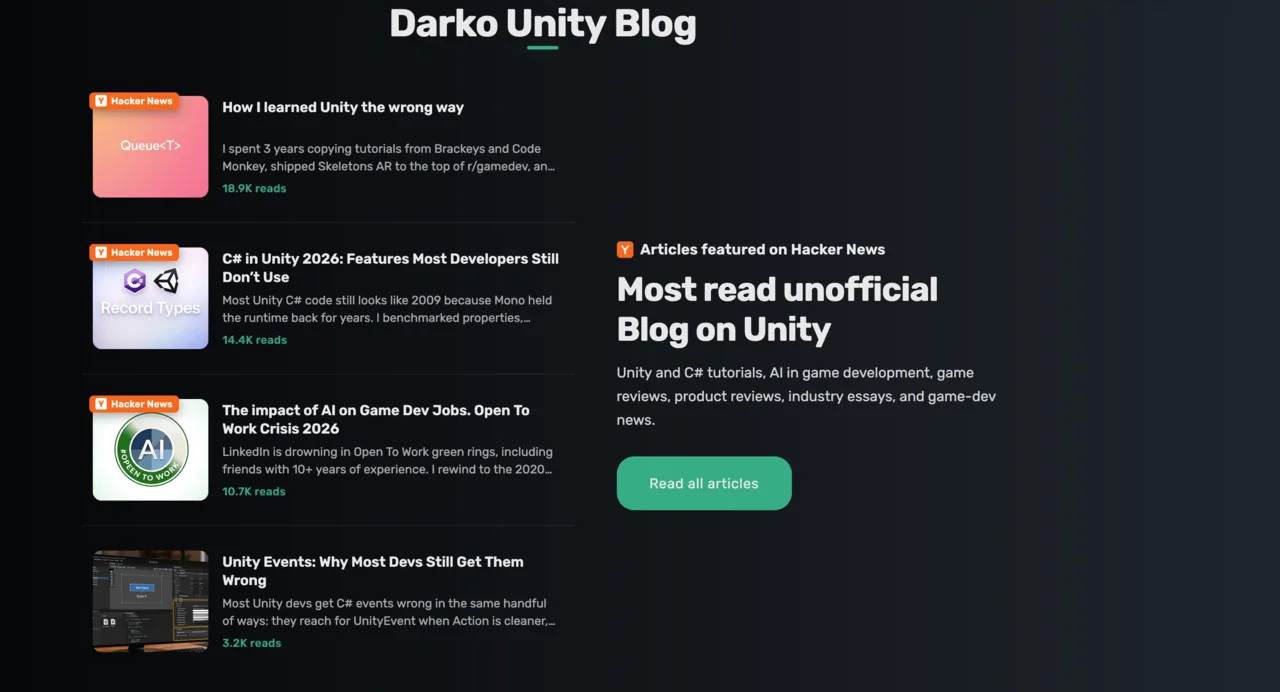
The reaction changed almost immediately. Readers started liking the articles, sharing them, and returning to the website. Manually written posts began averaging around 1,000 engaged reads. Three reached the Hacker News front page.
By July, Google Search Console showed 333,000 impressions and 1,460 clicks. The blog had also brought me three long-term tutoring students and 37 email subscribers.
Writing the content myself was not the only thing I improved. I made the website faster, added Cloudflare caching, generated responsive image sizes, improved Core Web Vitals, added structured data, enforced metadata, and built a better internal linking system. This was not a controlled experiment with one isolated variable.
It is an honest account of what happened when I stopped asking AI to create value for me and started using it to make my own work faster.
What writing my own content actually means
I did not stop using AI. I stopped asking it to decide what was worth saying.
My process now starts with choosing a pillar theme and finding a title. Then I write the argument, examples, opinions, and first draft myself. When I write a Unity tutorial, the examples come from my own projects, tutoring sessions, and 11 years of development experience.
The visuals are original too. I use my own screenshots, code examples, and HTML illustrations. Sometimes I add animations that demonstrate exactly what the text is explaining. I do not use AI-generated images for these articles.
Once the substance exists, AI helps me turn it into a finished article. Claude corrects my grammar, suggests title variations, checks the title and meta description lengths, reminds me to include a TL;DR, reviews the tags, and looks for missing internal or external links. My publishing system also prevents me from releasing an article without the required metadata.
I usually write directly inside Claude, which is connected to my blog backend. If a tutorial needs a screenshot, I can drag it into the conversation and tell Claude exactly where it belongs. It uploads the image, adds descriptive alt text, and inserts it after the correct paragraph.
That is the role I want AI to have.
AI handles the production system. It does not decide what I have to say.
What I count as a real read
Before showing the results, I need to explain what the numbers mean.
The read count visible on Darko Unity is not a normal pageview counter. I built a custom engagement system in the backend because I wanted something closer to the way YouTube treats a view.
A visit only becomes a read after the person scrolls beyond the introduction. Refreshing the page does not create another read for 15 minutes. The system includes anti-bot protections and honeypots for automated crawlers. My own visits are excluded because I regularly inspect published articles in production.
A read does not mean that somebody finished every paragraph. It means that the visitor moved beyond the introduction and read at least part of the article. Requiring a reader to reach the bottom would be misleading too, since useful articles often answer the reader's question before the final paragraph.
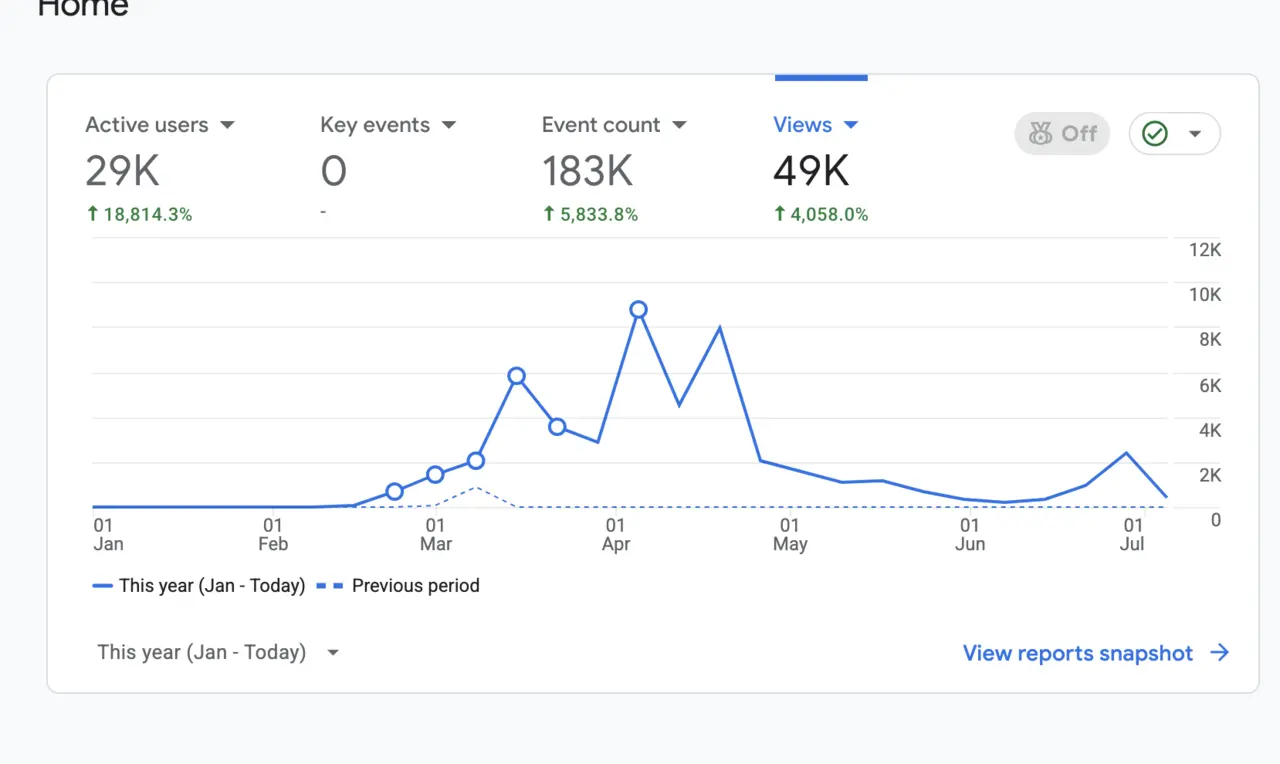
Google Analytics measures something different. Many of my readers use ad blockers or reject analytics consent, so they never appear there. This is why the 49,000 Google Analytics views in the screenshot below do not match the larger first-party read totals visible on the website.
The reaction changed immediately
The first difference did not come from Google. It came from readers.
When AI wrote the articles, people complained that they were generic. Most received fewer than 100 engaged reads. After I began writing from my own experience, articles started averaging around 1,000 engaged reads, excluding the exceptional Hacker News spikes.
I also started cleaning the archive. Darko Unity used to have 59 published articles. I deleted random posts that were unrelated to Unity and began rewriting weak Unity articles instead of throwing away their existing URLs.
One example is 10 Essential Tips Every Unity Developer Must Know. The original was a generic listicle that I had not even read myself. I replaced the entire article with lessons from real projects and tutoring, then added original code examples and animated HTML illustrations.
The rewritten page has now passed 1,400 engaged reads and has recently been gaining roughly 100 more every three days. Analytics often labels those visits as direct traffic, which Google Analytics reports as (direct) / (none). That can include links opened from private chats or email, but it does not prove where the sharing happened. I can only say that the article keeps growing without me publicly promoting it.
Keeping the old URL was intentional. The subject was still relevant and the page already had history. The content was the problem, so I replaced the content.
Three Hacker News spikes changed the blog
The most visible results came from Hacker News.
I discovered the first spike by watching my own analytics. Reads jumped from roughly 100 in a whole day to about 100 every few minutes. At first I thought the tracking system was broken. Then I opened Google Analytics and saw traffic arriving from Y Combinator.
As of July 10, 2026, these are the three Hacker News posts and their first-party engaged reads:
DateArticleHacker News discussionEngaged readsSubmitted byMarch 21The Impact of AI on Game Dev Jobs87 points and 71 comments10.7KMeApril 6C# in Unity 202678 points and 102 comments14.4KMeApril 16How I Learned Unity the Wrong Way181 points and 115 comments18.9KAnother reader
The third one mattered most to me. I submitted the first two myself, but somebody I did not know submitted How I Learned Unity the Wrong Way. I discovered it only after the analytics started climbing again.
That gave the article more credibility than anything I could have done myself. A random reader had found it useful enough to share without being asked. The initial spike brought more than 15,000 engaged reads, and the article has continued growing toward 19,000.
Hacker News traffic does not prove that Google rewards human writing. What it proves is that real readers found these particular stories worth discussing and sharing. That attention then created more opportunities for other websites, newsletters, and search engines to discover the work.
Google traffic continued after I stopped publishing
I added Google Search Console on March 1, so I use that as the official start of this case study.
By March 20, I had fully switched to publishing articles built from my own experience. I published regularly until April 25, then released only four more articles during May while I shifted my attention to TOMICZ, website development, and client work.
The current archive contains 47 articles published between March 1 and May 22. I was writing consistently for about two and a half months, not for the entire four-month measurement period.
By July, Search Console reported 333,000 impressions, 1,460 clicks, an average position of 8.4, and a click-through rate of 0.4 percent.
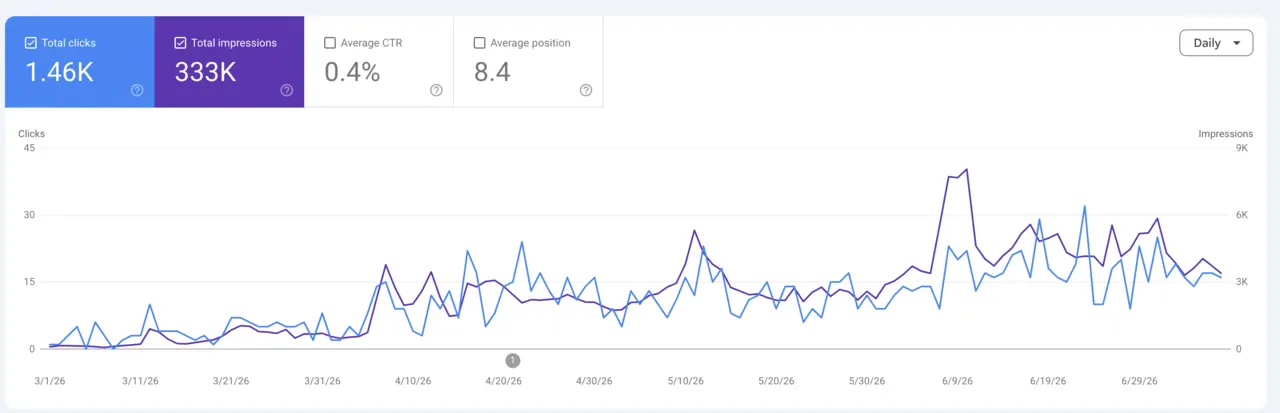
The 0.4 percent click-through rate looks low beside an average position of 8.4. AI Overviews are a likely contributor because many of my rankings are informational Unity searches that Google can partially answer on the results page. I cannot prove they explain the entire gap.
There is wider evidence that AI summaries reduce clicks. Pew Research Center studied 68,879 Google searches and found that users clicked a traditional result in 8 percent of visits with an AI summary, compared with 15 percent when no summary appeared. Ahrefs later measured a 58 percent lower click-through rate for position one pages when an AI Overview was present.
Google presents a different interpretation. It says AI search is producing more queries and that overall organic click volume is relatively stable, with clicks becoming more valuable. That claim is explained in Google's own report on AI Search and click quality.
Google introduced dedicated Search Generative AI performance reports in Search Console in June 2026, but the report has not appeared in my account yet. Until I have that data, AI Overviews remain a plausible explanation rather than a proven cause.
Writing was not the only thing I improved
This was not a controlled experiment where I changed one variable and held everything else still.
Darko Unity began as a portfolio website in 2024. It was much slower than the site that exists today. While improving the articles, I also rebuilt important parts of the publishing and delivery system.
I added Cloudflare caching. Every uploaded image is converted into multiple responsive sizes, and the website serves the size appropriate for the visitor's device. After that work, Core Web Vitals moved into the green.
I added structured data for articles, improved internal linking, and made metadata part of the publishing contract. Neither the CMS interface nor the connected AI tooling allows an article to be published without a title, meta description, tags, image information, and the other required fields.
When I publish a related article, I link it to useful older posts. When appropriate, I also update older articles with a link back to the new one. External claims receive links to original or reliable sources. New pages are submitted for indexing, although Google now tends to discover them almost immediately.
These improvements matter, but speed and metadata cannot make an empty article valuable. People were already willing to read the better posts before every technical improvement was complete. The website helped the content travel. It did not create the experience inside it.
Better content earned independent backlinks
The backlink profile grew because other people began finding and republishing the ideas.
The clearest example came after How I Learned Unity the Wrong Way reached Hacker News. The Japanese technology publication GIGAZINE wrote a full article about it on April 22.
Game Dev Digest issue 323 featured my UI Toolkit research. Issue 326 included the C# article. Issue 328 featured my article about math in Unity. Issue 329 included my guide to becoming a better C# programmer. Issue 331 featured my Unity AI Assistant review.
Third-party SEO tools noticed the growing link profile too. In July, Ahrefs measured a Domain Rating of 26 and 453 linking websites, while Semrush found 466 referring domains. These numbers are proprietary estimates and they are not Google ranking signals. They should not be treated as one universal authority score.
What matters is the pattern behind them. Readers shared the articles. Hacker News exposed them to larger audiences. Publications and newsletters linked to them. Those independent references gave search engines more evidence that the website was worth crawling and that the author existed beyond his own claims.
Traffic became a real business result
Traffic is useful, but it is not the reason I built Darko Unity.
So far, three long-term tutoring students have told me they found me through the blog tutorials. They also use the Unity learning roadmap and reached out through the website. I cannot share their identities, but they are real continuing client relationships rather than anonymous pageviews.
The website has also collected 37 email subscribers. That number is smaller than it should have been because I created the subscriber product late. The Beat Tutorial Hell roadmap now gives subscribers a structured path based on what I learned during 11 years of Unity development, but it did not exist when the first traffic arrived.
The path now looks like this:
Useful tutorial → roadmap → website enquiry → long-term student
That is a much more valuable result than a large impression count. The blog did not merely attract traffic. It demonstrated how I teach before somebody contacted me.
The mistake I would not repeat
If I started again, I would build a free product before publishing the first article.
I had traffic before I had the right reason for readers to subscribe. Those visitors learned something, left, and had no simple way to continue with me. I regret waiting because the first Hacker News spikes will never happen for the first time again.
The product does not need marketing fluff, fake scarcity, or a long email funnel. It needs value. If readers learn something useful from it, they will remember the website and come back.
That is the same standard I now apply to every article. The page should be useful even if the reader never hires me, subscribes, or clicks another link. Trust starts before conversion.
What this experiment proves and what it does not
This case study does not prove that Google detects AI writing and automatically punishes it. Google's guidance on generative AI says that AI can be useful for research and structuring original content. The risk comes from generating pages at scale without adding value.
The old version of this article claimed too much. I connected AI-generated content, model training, and Google rankings without evidence. I also implied that a Google update had specifically targeted AI slop. I should not have presented those theories as facts.
What I can show is what happened on my website:
- Generic AI-written articles usually received fewer than 100 engaged reads and readers openly rejected them.
- Articles based on my experience began averaging around 1,000 engaged reads outside viral spikes.
- Three articles reached the Hacker News front page, and the largest was submitted by an independent reader.
- Search Console reached 333,000 impressions and 1,460 clicks by July.
- The website developed a baseline of roughly 100 engaged reads per day without constant promotion.
- Independent publications and newsletters began linking to the work.
- The blog produced three long-term students and 37 email subscribers.
Writing the articles myself was only one part of the change. I also improved the tutorials, original visuals, website speed, Core Web Vitals, structured data, metadata, internal links, and distribution. I cannot isolate the exact contribution of each improvement.
The practical lesson does not require pretending that I can.
Google recommends helpful, reliable, people-first content that demonstrates experience, expertise, authority, and trust. That is what worked for me. The articles became useful because they contained lessons, examples, mistakes, and opinions that came from work I had actually done.
Do not rely on AI to create the reason people should trust you. Write your own content. Fact check it. Link to the evidence. Add original examples and visuals. Use AI to improve the production process, but do not let it manufacture your experience or another person's opinion.
AI can make your work faster. It should not become the source of your brand authority.