Why VUKASINÉ Started Booking Meetings After Launch
TL;DR VUKASINÉ did not start booking meetings because the website became the lead source. The new site, professional email, CRM, and stronger brand signals made cold outreach feel credible enough for buyers to reply.
VUKASINÉ did not have a lead problem. It had a trust problem.
The owner was already doing the hard part. He was reaching out to showrooms, architects, interior designers, studios, furniture retailers, and anyone else who could realistically buy or specify the furniture.
But the outreach was being sent from a personal Gmail account.
From his side, that was practical. It was the only email that worked. From the buyer's side, it looked wrong. A cold email from an unknown furniture workshop already asks for trust. When it arrives from a personal inbox, links to a weak website, and reads like a template, the buyer has very little reason to continue.
When we met in person, he told me what had been happening. He had sent emails and heard nothing back. Not a few bad replies. Not polite rejection. Nothing. Most of those emails probably never made it past junk, and the ones that did were easy to ignore.
That changed after the new VUKASINÉ website launched.
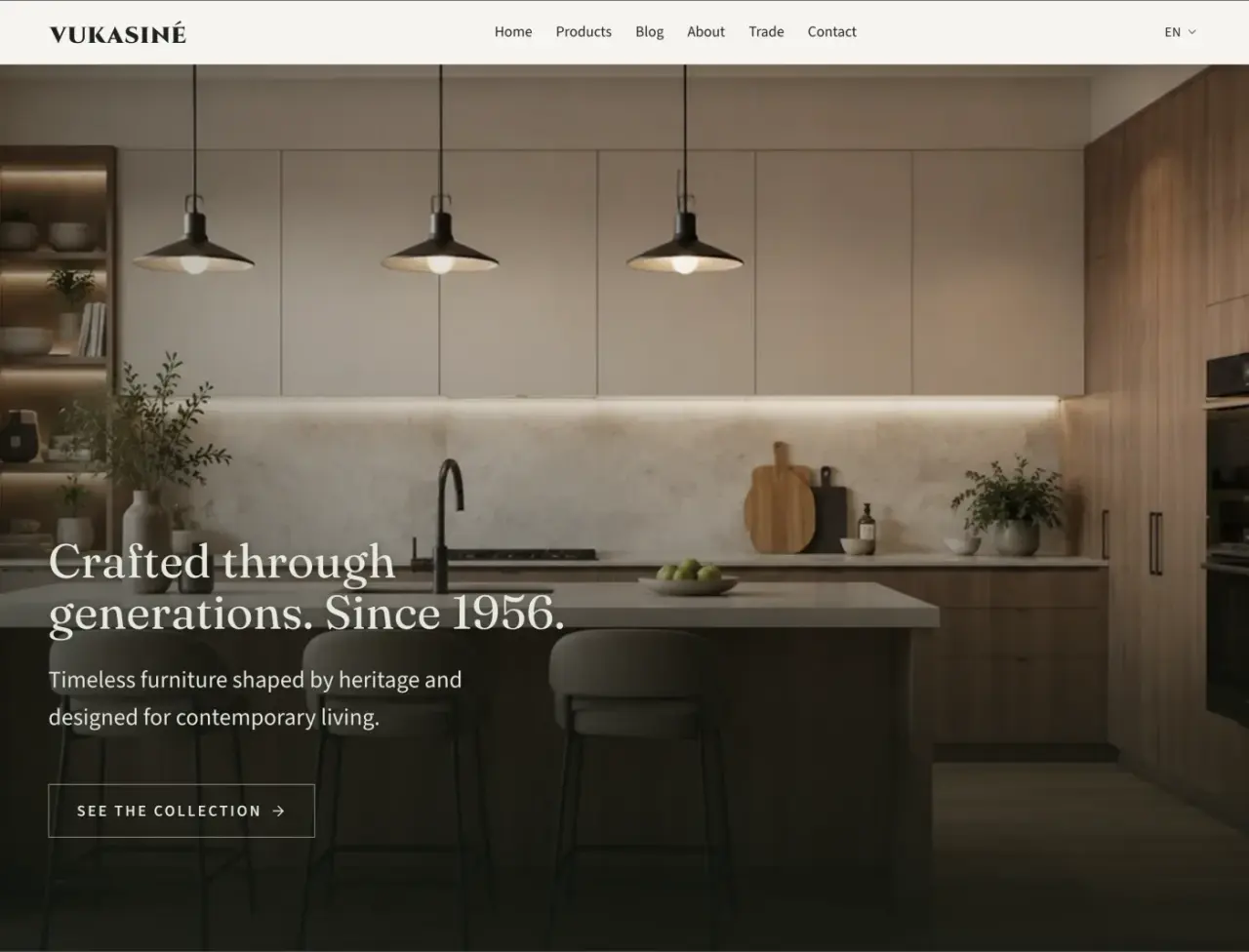
The website did not find the leads for him. It made the outreach believable. The buyer could click through, see a premium furniture maker, understand the Providenca collection, and reply from a place of trust instead of suspicion.
The Problem Was Not the Cold Email
Cold email was not the real problem. The problem was everything around the email.
Before the new site, VUKASINÉ had another website for a company in the same industry. It had been built quickly in WordPress and looked like the kind of template most buyers have seen too many times. It was not useless, but it did not make the business feel like a premium supplier.
That matters more than people think.
A trade buyer does not know the owner. They do not know the workshop. They do not know whether the business can supply showrooms, handle communication, or represent a product line professionally. The website has to answer those doubts before the buyer risks a reply.
The email setup made the problem worse. The professional email on the old website existed, but it did not work properly. If someone tried to contact him through it, he could not reliably receive the message. So the only working option was his personal Gmail account.
That is a dangerous place for a business to be. Even if the product is good, the first impression says the opposite.
The emails themselves were also too templated. They were going to the right kinds of people, but they did not feel written for the person receiving them. A showroom, an architect, an interior studio, and a furniture retailer do not all need the same message. They may all care about the same collection, but they care about it for different reasons.
There was one more problem. After the old website was marked finished, updates became difficult. The agency was hard to reach, and even small changes were slow. That creates a second kind of damage. The business stops treating the website as a live sales asset and starts treating it like something frozen. Website as a Service is built around continued responsibility after launch, and I compare that model with one-time website builds in more detail.
At Tomicz, I think about websites differently. A website should be easy to improve after launch. We train clients to use the CMS, make their own edits, and update the parts they should control. That is why we built the Tomicz CMS around the real things businesses need to change after launch.
If they want something deeper than a website, we also build custom software around the business itself. And if they want to work with AI tools, the site should not fight that either. They can connect an AI CLI or desktop app and let it inspect, suggest, and change content directly.
That does not mean every business needs to throw away its current website. If the existing technology is solid enough, even if it is WordPress, we can help improve what is already there. But when the site is slow, generic, hard to update, and disconnected from the actual sales process, the technology has become part of the sales problem.
That is what happened here. The cold email was only the visible part. The real issue was that every trust signal around it was weak.
What Changed After the Website Launch
The change did not happen the minute the website went live. It happened about a week later, after the product renders were added and the site finally showed the collection properly.
That detail matters. A premium website cannot carry weak product presentation. The site gave VUKASINÉ a serious frame, but the renders gave buyers something concrete to judge. Once both were in place, the outreach started turning into meetings.
At first, the owner was still trying to manage the conversations in his head and inside the mail client. That worked when nobody replied. It stopped working as soon as people started booking calls.
His CRM inside the Tomicz CMS started filling up quickly. That was the moment the value of the system became obvious. A website can create trust, but a business still needs a place to manage the conversations that trust creates. He started using the CRM daily because the problem had changed. Before, the question was why nobody replied. After launch, the question was how to keep track of the replies, calls, and follow-ups.
The result was not one lucky meeting. He started booking one or more meetings per day.
Several things changed at the same time. The website looked professional. The emails became more personalized. The business now had a proper system for handling leads. His Instagram and LinkedIn also looked consistent with the new website, which matters more than many businesses think.
A buyer rarely checks only one thing. They read the email, click the website, glance at social profiles, and decide whether the company feels real. If the website looks premium but the social profiles look abandoned, trust leaks out. If the email looks personal and the website looks like a template, trust leaks out again.
VUKASINÉ worked because the signals started matching. The collection looked premium. The website looked premium. The owner himself presented well. The whole thing felt like a real supplier, not a random cold email asking for attention.
People noticed. Not only potential buyers, but friends, acquaintances, coworkers, and clients started asking who built the website. One new client came to Tomicz through VUKASINÉ because the quality of the site made them ask that question.
I was not shocked by the result, but not because I think this work is magic.
I have spent 11 years talking to clients, watching how businesses present themselves, and seeing how little effort many competitors put into the basics. A lot of companies are sold template websites that look finished on paper but do not help the business sell, follow up, or stand out.
That is why the bar is lower than people think.
If your competition looks generic, replies slowly, sends cold emails from weak accounts, and treats the website like a static brochure, doing the fundamentals properly can move the business forward fast.
Why Buyers Needed Proof Before Replying
I do the same thing buyers do.
If I receive a cold email and it looks spammy, I send it to junk. I do not investigate it deeply. I do not give it a second chance. Most business owners are already overloaded with bad outreach, so their filter is brutal by default.
That is the reality VUKASINÉ was walking into.
A buyer does not open a cold email from an unknown furniture supplier and think only about the furniture. They think about risk. Who are these people? Is this a real workshop? Can they communicate professionally? Can they deliver? Is there history behind the company, or is this just another random supplier trying to look bigger than it is?
The new setup answered those questions better.
We added a professional email signature, both in the mail client and inside the Tomicz CRM, so even the email itself carried more trust. Then the website gave buyers a place to verify the business. They could see the people behind it, the workshop history, the Providenca collection, the product renders, and the trade focus.
That is important because the buyer is also a business.
A showroom or interior designer is not replying as a casual customer. They have to make money from the relationship. If they take on a new supplier, recommend the product, or build a client proposal around the furniture, the risk sits with them. VUKASINÉ may know the quality of the work. The buyer does not know it yet.
That is why the offer had to reduce risk.
Bosnia was not a weakness here. VUKASINÉ had already sold outside Bosnia before. The owner understood export, packaging, transport, and the practical work of making sure furniture arrives without damage. He already had relationships with trusted transporters. The website did not need to hide where the workshop was. It needed to make the buyer feel that the company was serious enough to trust internationally.
The pricing also had to be handled carefully.
VUKASINÉ is not selling retail furniture directly from a public price list. The offer is wholesale and trade focused, mainly for showrooms and designers. Prices belong in direct conversations, not on the public website. Showing them too early would weaken the premium positioning and make it harder for trade buyers to protect their own margin.
Trust is built in layers. The email has to look real. The signature has to match the brand. The website has to explain the company. The product presentation has to justify the conversation. The social profiles have to support the same story.
As VUKASINÉ grows, meets more people, and gets more work into the market, trust will become easier. But early on, the buyer carries most of the risk. The job of the website was to lower that risk enough for the first reply.
The Details That Made VUKASINÉ Feel Legitimate
The first thing I cared about was speed.
VUKASINÉ has a large image in the hero, but the page still loads fast. Not "fast enough." Actually fast. Faster than most competitor sites in the same space, especially the template-heavy sites that look fine for a second and then fall apart under real loading conditions.
That matters because speed is part of trust.
A buyer may not open Lighthouse or check Core Web Vitals, but they feel the difference. A fast site feels maintained. A slow site feels neglected. If a supplier's website struggles to load a few pages, it quietly raises the question of whether the rest of the business is handled the same way.
The site was built mobile first too. It loads quickly on mobile, the layout holds together, and navigation is simple. Visitors do not have to figure out where to go. They can see the collection, understand the workshop, find the trade path, and contact the business without getting lost.
Technically, a lot is happening behind that simple experience. The site runs through Cloudflare. Images are served in multiple sizes for different screens and network conditions. Core Web Vitals are green. Metadata, structured data, contact forms, CRM connection, and email routing are all part of the same system.
Most buyers will never know those details exist.
That is fine. The point of good technical work is not to make the visitor admire the stack. The point is to make the business feel serious before the visitor has a reason to doubt it.
The design had to do the same thing.
We did not try to make VUKASINÉ look loud. The site uses custom colors, minimal layouts, simple navigation, a beautiful font system, and real imagery instead of stock photography. The furniture had to carry the page. The website's job was to frame it, not compete with it.
The positioning became clearer as the site grew.
We did not want random furniture jargon. We wanted a message that actually reflected VUKASINÉ. That is how the site moved toward the core idea: one collection, made to last. The business did not need to pretend it had a giant catalogue. The focus was the strength.
That consistency is probably the part I like most. The homepage, collection pages, trade flow, about story, forms, and social presence all point in the same direction. Nothing feels like it came from a different template or a different agency mood board.
That is also the advantage of building on the Tomicz framework. Performance, responsive images, metadata, structured data, forms, CRM, and the content system are not extra decorations added at the end. They are part of the way the site is built from the start.
What This Taught Me About Outbound Websites
This project confirmed something I already believed: cold email outreach is not dead. A lot of people just do it badly.
They send the same template to everybody, from an email account that does not look trustworthy, with a website that does not make the business easier to believe. Then they say cold email does not work.
But the buyer is not judging only the email.
If the email is interesting enough, they research you. They click the website. They search the brand on Google. They check whether the business looks real. I can see this happening with VUKASINÉ in Google Search Console. Brand clicks started growing because prospects were looking him up after the outreach.
That is a documented signal on our end, and it changes how I think about outbound.
The website is not only a landing page. It is the place where the buyer checks whether replying is worth the risk. For an outbound business, the job is simple. Look professional and credible before the prospect decides whether to answer.
VUKASINÉ also made me more confident in the Tomicz model.
The website mattered, but the website alone was not the whole system. The professional email mattered. The CRM mattered. The CMS mattered. The ability to update things quickly mattered. The owner became one of the biggest contributors to our internal CRM features because he was actually using it every day.
That feedback loop is valuable.
The Tomicz CMS has a ticketing system where clients can send feature requests. VUKASINÉ used it, and those requests helped expand the CRM around real business use instead of imagined features. He liked having everything in one place. He did not have to glue together a website, a CRM, a ticketing tool, and another subscription just to manage the basics.
That is one of the things I dislike about many website stacks. Even in WordPress, you often start paying for plugins once the business needs more than a brochure. With our ecosystem, the CMS and CRM are part of the system for clients who build with us.
The project also changed one technical assumption for me.
At first, I thought a static site made sense for smaller businesses that are not online businesses in the way an ecommerce store is. Static pages are fast, simple, and good for SEO. VUKASINÉ was initially built that way because speed mattered.
But the more the system grew, the more I saw the maintenance cost. When the site needs instant changes, CMS updates, CRM integration, and less deployment overhead, server rendering becomes the better default. With Cloudflare caching, we can get close to static site speed while keeping changes immediate.
That is why we moved VUKASINÉ to SSR, and why future Tomicz websites are moving in that direction too.
The lesson was not that every business needs a complicated platform. The lesson was that a business website cannot be separate from the sales process. If outbound creates attention, the website, email, CRM, and content system have to turn that attention into trust.
The Lesson for Businesses Doing Cold Outreach
If your cold outreach is not working, do not start by blaming the channel.
Start by checking the trust signals around it.
Before a business sends cold emails, the basics need to be in place. The brand should look consistent. The social profiles should not feel abandoned. The email should come from a professional domain and include a proper signature. The website should look good, load fast, explain the offer, and make it easy for the prospect to understand who they are dealing with.
Then the email itself has to be written for the person receiving it.
That is where many businesses go wrong. They spam other businesses with the same template, then treat silence as proof that cold outreach is dead. It is not dead. The recipient just has no reason to trust or care about what was sent.
If you already have a website, the answer is not always to rebuild everything.
Sometimes the right move is to improve the existing system. We can work with WordPress and other CMS setups when that makes sense. If the foundation is usable, it may be better to optimize what already exists instead of forcing a migration.
Other times, the site needs a deeper rebuild. At Tomicz, our websites are custom built with Next.js and Node.js, with a headless CMS behind them when the client needs one. The website can still work without the CMS. The CMS exists to make editing, CRM, content, media, and business workflows easier, not to trap the website inside a tool.
That flexibility matters.
A small business does not need more software for the sake of software. It needs the right system around the way it sells. For VUKASINÉ, that meant a premium website, professional email, stronger social presentation, CRM, and a clear trade-focused message. For another business, the answer may be different.
But the principle is the same.
If you tried cold email and it did not work, the problem may not be cold email. It may be that nobody had enough reason to trust you after opening it.
At Tomicz, this is the kind of work we help businesses fix. We look at the website, email, branding, content, technical setup, and sales process together, because prospects do not experience those things separately. They experience one impression.
If that impression feels weak, they ignore you.
If it feels credible, they reply.